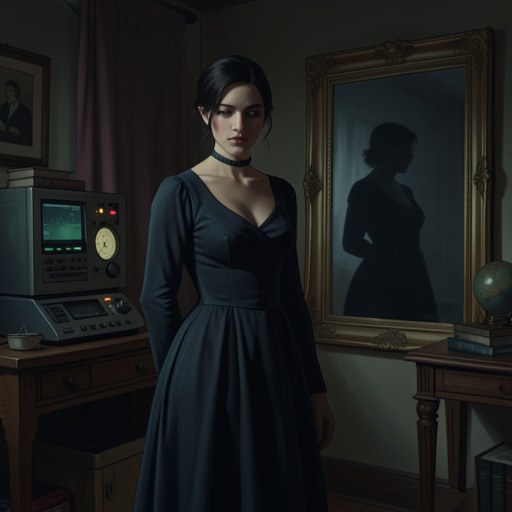
Mrs. Rusk
Uncle SilasMrs. Rusk, the housekeeper at Knowl, is a loyal servant whose brisk care, distrust of Madame de la Rougierre, and knowledge of the household make her an important early protector of Maud. Her blunt judgments do not always amount to proof, but they give Maud a practical counterpoint to the mysterious claims and appearances that surround her, and her account of Austin Ruthyn’s death supplies crucial facts when the household is in shock.
Identity and Place in the Household
Mrs. Rusk belongs to the domestic world of Knowl, where she manages the house and attends to Maud’s needs. She is present in the hunting-room supervising preparations for an expected visitor, counting linen and giving orders. She is also part of Maud’s ordinary routine: the old carriage takes Maud, her governess when she has one, and Mrs. Rusk to church on Sundays. The household’s daily arrangements place her in a position to observe both visitors and changes in the home.
Her loyalty to Austin is distinct from agreement with his beliefs. Austin has left the Church of England, eventually becoming a Swedenborgian, while Mrs. Rusk remains a staunch and often bitter churchwoman. Maud acknowledges that Mrs. Rusk’s accusations about Austin’s supposed supernatural pretensions rest on analogy and conjecture, not established knowledge. At the same time, Maud says that outside matters of religious orthodoxy, Mrs. Rusk loves her master and serves him loyally. That qualification captures the limits of her judgment as well as its emotional basis.
Distrust of Madame de la Rougierre
Mrs. Rusk reacts sharply when Madame de la Rougierre arrives as Maud’s governess. She tells Maud that she dislikes the new governess, complains about her appearance and appetite, and resents the preference for foreign governesses over English women. The remarks are coarse and prejudiced, but they establish an open hostility that soon becomes more than dislike.
As Madame settles into Knowl, Mrs. Rusk voices practical suspicions about her unexplained background and her closeness with Anne Wixted. She says that no one in the household knows where Madame came from or whom she had previously served, and alleges that Madame took Austin’s prescribed gin and diluted what remained. She also reports that servants fear Madame and describes an episode in which Catherine Jones found her asleep in bed fully dressed after a disagreement with Maud. Some of Mrs. Rusk’s conclusions—that Madame might be a witch or a ghost—are the household’s fearful speculation, not verified fact. Yet Maud recognizes that Madame’s manner has made her nervous, and suspects that Madame takes pleasure in that effect. Mrs. Rusk’s warnings therefore register both the real uncertainty around the governess and the way fear grows within the house.
The attack on Maud and Madame during their outing sharpens Mrs. Rusk’s suspicions. After Madame blames Maud for the danger and speaks with unusual virulence, Mrs. Rusk calls her a hypocrite and an old witch, insisting that such trouble had not occurred at Knowl before her arrival. Her angry reaction does not establish what Madame knew or intended. It does, however, give Maud a new and alarming possibility to consider: that Madame’s advice and proposed excursion to Church Scarsdale may have served a purpose other than the one she claimed. Maud remains unable either to prove or wholly to dismiss the suspicion, and the episode deepens her sense of danger.
Care During Crisis and Austin’s Death
Mrs. Rusk’s practical role becomes most visible during the night of Madame’s intrusion into Austin’s room. Maud is left frightened and unable to move from her hiding place; after the night, she is ill and feverish. Madame visits her at the bedside with a composed, affectionate manner, showing no visible sign of having been awake. Maud’s account of this encounter places Mrs. Rusk’s warnings in a darker context, though Mrs. Rusk herself is not shown witnessing the intrusion.
When Austin dies, Mrs. Rusk is among the people managing the immediate confusion. Hearing men at work and the sound of a heavy body being moved, Maud asks what has happened. Mrs. Rusk comes to her pale and distressed and urges her to return to her room rather than witness what is taking place. She gives Maud no explanation in that moment, but tries to shield her until she can bear to know more.
Mrs. Rusk later supplies the circumstances of Austin’s death. He had seemed unusually well that evening. After returning from the study with a book Austin had requested, she found him making notes on passages related to his current religious reading. He took the book and kept her in the room; then, as he climbed onto a chair to reach another book on a shelf, he fell and died. His body fell across the door, making it difficult for Mrs. Rusk to force it open. This account explains both the crash Maud heard and the distress surrounding the room’s entrance. It also gives the death an ordinary, documented sequence after the novel has framed the expected visitor in ominous terms.
Farewell to Maud and Narrative Significance
When Maud leaves Knowl for Bartram-Haugh under the guardianship arrangement in Austin’s will, Mrs. Rusk remains behind to care for the house, birds, and dogs. On Maud’s last morning, the house is largely emptied: most of the servants have gone, doors are locked, and the drawing room is being washed. Mrs. Rusk embraces Maud and tries to make the separation feel temporary, promising to look after the household and offering to visit her and Mary Quince in Derbyshire. Her joking hope that Maud may return with a distinguished young husband is affectionate reassurance, not knowledge of what awaits her.
The contrast between that farewell and Maud’s arrival at Bartram-Haugh is sharp. Mrs. Rusk leaves Maud with promises of care and a familiar home, while the new residence presents itself as grand but neglected, with fallen trees, overgrown ground, and a melancholy air of abandonment. Mrs. Rusk does not accompany Maud into the increasingly controlled spaces of Bartram-Haugh, but her earlier warnings help establish the pattern by which household knowledge and domestic care can become forms of protection. In the story’s opening movement, she is neither an all-knowing investigator nor an infallible judge: she is a loyal, opinionated housekeeper whose observations matter because she notices what others would rather leave unexplained.